Publication
Increased Tariffs on Chinese Electric Vehicles and Other Goods Expected to Impact Numerous Economic Sectors

The Biden administration recently announced an increase in trade tariffs on Chinese electric vehicles (EVs) and related goods under Section 301 of the Trade Act of 1974. This executive order by the President likely increases many of the regulatory uncertainties already impacting numerous economic sectors of the EV industry across the United States as U.S. policymakers seek to transition half of U.S. automobiles to EVs by 2030.
According to a recent statement by the Biden administration, this executive order aims to, “protect American workers and American companies from China’s unfair trade practices,” and, “encourage China to eliminate its unfair trade practices regarding technology transfer, intellectual property, and innovation.” While the implications for the EV industry are still being sorted out by regulators and multi-national businesses alike, one thing is certain—regulatory uncertainty across the EV industry will remain in place between now and election day this November.
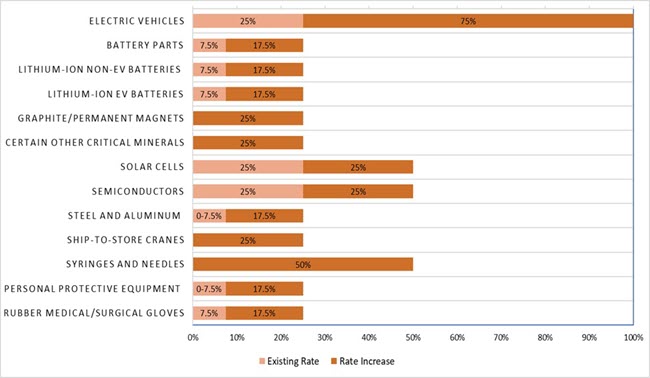
The Biden administration’s economic plan instructs the U.S. Trade Representative’s Office (USTRO) to maintain tariffs previously established by the Trump administration and either (1) impose new tariffs; or (2) increase existing tariffs across various “strategic sectors,” including “steel and aluminum, semiconductors, electric vehicles, batteries, critical minerals, solar cells, ship-to-store cranes, and medical products.”
President Biden also is directing the USTRO to publish a proposed list of corresponding products and exclusions, along with procedures for submitting exclusion requests. After the applicable notice and comment period, final determination on tariff rates, affected products, exclusion availability, and the exclusion process will be issued. Depending on the product, rate increases will become effective between 2024 and 2026.
A closer look at President Biden’s recent tariffs on Chinese EVs and other goods explains how these tariffs could impact numerous sectors of the EV economy. The following chart illustrates the specific Chinese EVs, critical minerals for EV batteries and other products impacted by these tariffs:
These new tariffs follow several years of debate regarding the adoption of EVs in the U.S. economy and subsequent federal policies and incentives to encourage EV consumption in the United States. In 2022, the passage of the Inflation Reduction Act (IRA) provided billions in tax credits and incentives for clean energy, battery manufacturing, and EV sales and manufacturing, with certain requirements that the vehicles be assembled in North America. Recent guidance by the Departments of Treasury and Energy permit EVs containing Chinese graphite to remain eligible for certain IRA tax credits under certain conditions. While reduced importation of Chinese EVs seeks to protect the U.S. auto industry, it is also likely to complicate the supply chain for American EV manufacturers, especially those reliant on materials like graphite for battery production. Companies that have invested into new processes or facilities to build EVs—possibly in response to the IRA or the tighter standards on tailpipe emissions—could now face other regulatory challenges in light of these new tariffs.
Ice Miller regularly advises clients on how to navigate complex and changing regulatory and trade landscapes, which may also be subject to certain political pressures and factors. Ice Miller has extensive experience in advising clients on previously imposed tariffs, including securing tariff exemptions and filing objections to tariff exemption requests, filing comments during the agency’s comment period, and advising clients on alternative solutions to addressing the tariffs’ impact on their business. Currently, Ice Miller also represents a number of plaintiffs challenging the existing Section 301 tariffs on Chinese goods in the Court of International Trade, the test case for which is on appeal to the U.S. Court of Appeals for the Federal Circuit. Ice Miller also advises businesses on federal tax incentives, including for federal IRA credits and incentives. In the EV industry, Ice Miller’s experience includes a key representation of a prominent global lithium battery company engaged in a significant joint venture to manufacture battery cells for commercial vehicles. These practices provide a reliable foundation for clients and companies who seek to navigate this changing regulatory and international trade landscape.
Given the regulatory and business uncertainties facing the United States’ EV industry and other industries affected by this tariff increase, Ice Miller’s Government Affairs & Regulatory Law and International Business groups will continue to closely monitor this evolving regulatory situation and develop market entry strategies for clients based upon the applicable laws and regulations. Please reach out to Meghann Supino, Sean Kim, or Grace Dahm if you have any questions, would like assistance determining how these changes may impact your business, or need to take action to address the consequences of these actions, such as requesting tariff exclusions.
This publication is intended for general information purposes only and does not and is not intended to constitute legal advice. The reader should consult with legal counsel to determine how laws or decisions discussed herein apply to the reader's specific circumstances.