Publication
TTAB Denies Trademark Protection to Cannabis Marks in BAKKED Applications
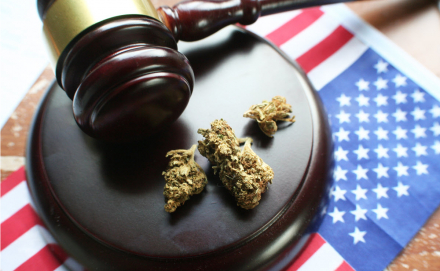
In its precedential decision, In re National Concessions Group, Inc., the Trademark Trial and Appeal Board of the United States Patent and Trademark Office (“TTAB”) refused trademark registration for the marks BAKKED, and a tear-drop logo for “essential oil dispenser[s] sold empty for domestic use”, finding the goods to be prohibited drug paraphernalia, and hence not lawful use of a mark, even though the specification of goods was for a product with a non-cannabis intended use. In its decision, the TTAB in a matter of first impression, held that the drug paraphernalia exemptions of Sections 863(f)(1) and 863(f)(2) of the Controlled Substances Act, that the cannabis product is legally sold within the states of sale, and that the goods in question have a non-cannabis use, do not apply and are preempted. The trademark owner has not appealed the decision to date.
The trademark owner/applicant, National Concessions Group, is a large cannabis company based in Colorado, where it sells cannabis goods legally. The trademark owner sought federal registration of two of its marks for “[e]ssential oil dispenser, sold empty, for domestic use.” Both applications (87/183,434 and 87/168,058) submitted the following specimen as proof of use:
(The mark THE DABARATUS was not the subject of a federal trademark application. The applied-for house marks appear on the left-hand side of the specimen of use.) The applied-for marks appeared to be on the path to registrability after the trademark owner confirmed that the essential oil dispensers were not sold pre-filled with essential oils of any type, and additionally attested to its best knowledge and belief that goods covered by the mark were compliant with the Controlled Substances Act. When the specimen of use was submitted, the Trademark Examining Attorney took another look and found that extrinsic evidence revealed that the trademark owner’s empty essential oil dispenser was primarily used for “dabbing” and therefore constituted prohibited drug paraphernalia.
On ex parte appeal to the TTAB, the trademark owner argued unsuccessfully that the Controlled Substances Act exemption applied because, as a Colorado company, it was a “person authorized by . . . state . . . law to manufacture, possess, or distribute such items,” thus qualifying under Section 863(f)(1). Additionally, the trademark owner argued the product in question could also be used for tobacco, or other federally legal products, and thus qualifying under Section 863(f)(2).
In upholding the Trademark Examining Attorney’s refusal to register two marks under the Controlled Substances Act, 21 U.S.C. §§ 1051 and 1127, the TTAB held that the goods’ “primary intended purpose is to dispense premeasured amounts of cannabis-based oil to a vaping or smoking device for ‘dabbing.’” The extrinsic evidence included the trademark owner’s website; articles explaining the dabbing process; and online third-party articles specifically describing the trademark owner’s “essential oil dispenser” as a dabbing tool.
The TTAB further rejected the trademark owner’s argument analogizing the essential oil dispenser to trademark applications for goods such as razor blades and postage scales, which are also commonly used for illegal drugs, finding that those products are primarily used for legal purposes, while here the primary purpose of the goods was as drug paraphernalia.
According to the TTAB, this was a matter of first impression of the registrability of a federally banned cannabis, or cannabis- related product under the Controlled Substances Act exception for businesses that are authorized by state law to manufacture, possess or distribute the goods. The TTAB found that Colorado’s laws have no effect regarding the state or federal laws outside Colorado.
This decision demonstrates that absent action at the federal level regarding the legality of cannabis and cannabis-related products, cannabis brand owners seeking protection of trademark rights should not rely on federal trademark rights but should instead obtain state trademark registrations in states where cannabis is legal, and rely upon state law grounds of trademark infringement, unfair competition and passing off, where applicable.
For a broader overview of issues relating to trademark protection for cannabis-related trademarks, see Ice Miller attorneys Kristina S. Dahmann’s and Jacqueline M. Lesser’s recent article detailing the status of trademark protection for cannabis brands.
This publication is intended for general information purposes only and does not and is not intended to constitute legal advice. The reader should consult with legal counsel to determine how laws or decisions discussed herein apply to the reader's specific circumstances.