Publication
Warning Siren or Alarm Bell of Opportunity

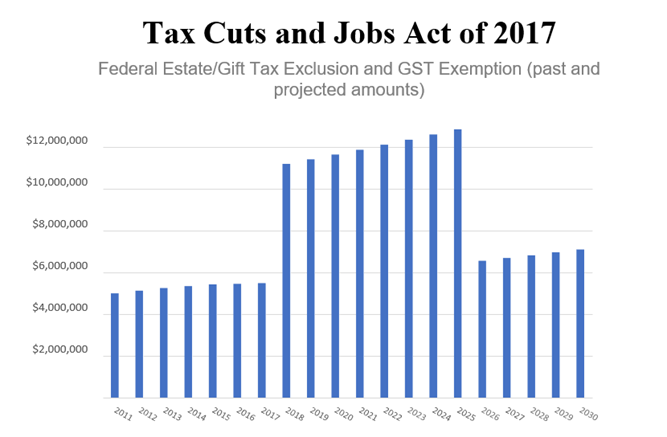
The 2017 Tax Cuts and Jobs Act (TCJA) radically changed tax laws, including those governing transfer taxes. Most notably, the exemption to the federal gift and estate taxes doubled, to the benefit of taxpayers. However, the TCJA was passed with “sunsetting” provisions that will wipe out those increases to the gift and estate tax exemption in fifteen months’ time.
Estate, Gift, and GST Taxes
The federal gift and estate taxes are, of course, separate from income tax, and can be triggered by gifts or transfers of your property during your lifetime or through your estate plan at death. The exemption is an allowance of sorts, it is an amount that you can transfer cumulatively before you pay a gift tax for gifts during your lifetime, or estate tax that your estate pays for transfers upon death.
The gift and estate tax exemption amount in 2024 is $13,610,000. Your lifetime taxable gifts reduce the exemption available to your estate at death. There is also a separate tax, the generation-skipping transfer tax (GSTT), that can be applicable when assets are gifted to someone two or more generations below you, for example, a grandchild. It too has a current exemption of $13,610,000.
Sunset, See You, Bye…
Provisions of the TCJA are scheduled to sunset at the end of 2025, and the estate/gift tax exemption and GSTT exemption are scheduled to decrease to approximately $7,000,000 in 2026 if no changes are made to the law before then. The numbers are approximate because of inflation adjustment, but a simplified summary is that approximately $7,000,000 of each of these two exemptions will “disappear.”
For larger estates, the impact of the 2026 scheduled sunset is obvious—the prospect of gift or estate tax for individuals with wealth in excess of $7,000,000 ($14,000,000 for a married couple). What is not as obvious is that gifts in excess of the reduced exemption amount must be made to capture the “disappearing” exemption. For example, if you transferred $7,000,000 of your business’s stock to a child in 2024 and the exemption drops in 2026 to $7,000,000, you would have no exemption remaining in 2026. Your 2024 gift did not make use of your disappearing exemption (the decrease from $13.61 million to $7 million). The “use it or lose it” nature of the exemption might catch taxpayers by surprise.
Act Now, Allow for Proper Planning
For families with large estates, whether in the form of business ownership or otherwise, they must ask themselves whether gifting or transfers in 2024 or 2025 make sense. Because of the size of the exemptions and the amount of the pending reduction, such gifts could be large. With large gifts come many considerations that include: what assets would be transferred; how would your wealth and cashflow be impacted; are valuations required for gifted assets; and will the gifts be made outright or in trust.
As to the last point, trusts can become an important component of larger gifts due to the structure, management, and creditor protection they allow for the beneficiary and peace of mind for the giver. In specially structured trusts, beneficiaries can include the giver’s spouse. Trusts also allow for allocation of GST tax exemption to the gifted property so that it may benefit multiple generations without a later imposition of the estate or GSTT.
The planning, structuring, valuation work, and implementation take time, and while 2026 can seem far off, it is not in comparison to an adequate timeline for this work. We, of course, are also cognizant of the possible impact of this year’s elections. No election result, though, will guarantee a solid legislative solution prior to 2026 and the only “known” is the opportunity that currently exists.
If you are interested in discussing these pending changes and your subsequent planning, we encourage you to begin those discussions now to allow for proper deliberation and action.
This publication is intended for general information purposes only and does not and is not intended to constitute legal advice. The reader should consult with legal counsel to determine how laws or decisions discussed herein apply to the reader's specific circumstances.