Publication
The Data Behind the Dispensary: Why Cannabis Cybersecurity and Consumer Privacy Matter More Than Ever
Imagine walking into a dispensary to purchase a legal product and being asked to provide your driver's license, address, date of birth, medical information, and purchase history. Most consumers assume that if a business is required to collect that much sensitive information, it is also required to protect it.
In the cannabis industry, that assumption may not always be true.
As cannabis markets expand, dispensaries have become highly data-intensive businesses, collecting and storing detailed personal, medical, and transactional information to meet state tracking requirements. While this supports compliance, it also creates significant cybersecurity and data privacy risks: large, sensitive datasets that are attractive to attackers and highly damaging if exposed.
What Data Do Dispensaries Collect From Customers?
Every purchase leaves a digital trail. A single dispensary visit or transaction can generate a detailed record, including:
- Full name, address, and date of birth
- Government-issued identification numbers
- Medical marijuana card details
- Purchase history, including products, quantities, and frequency of use
In industries such as healthcare, this level of information is governed by well-established federal frameworks like Health Insurance Portability and Accountability Act (HIPPA).
Cannabis businesses, however, often operate within a patchwork of state regulations shaped by state legalization and ongoing federal prohibition. As a result, operators may be required to collect extensive information without the benefit of consistent privacy requirements across jurisdictions.
A System Built to Track, Not Necessarily to Protect
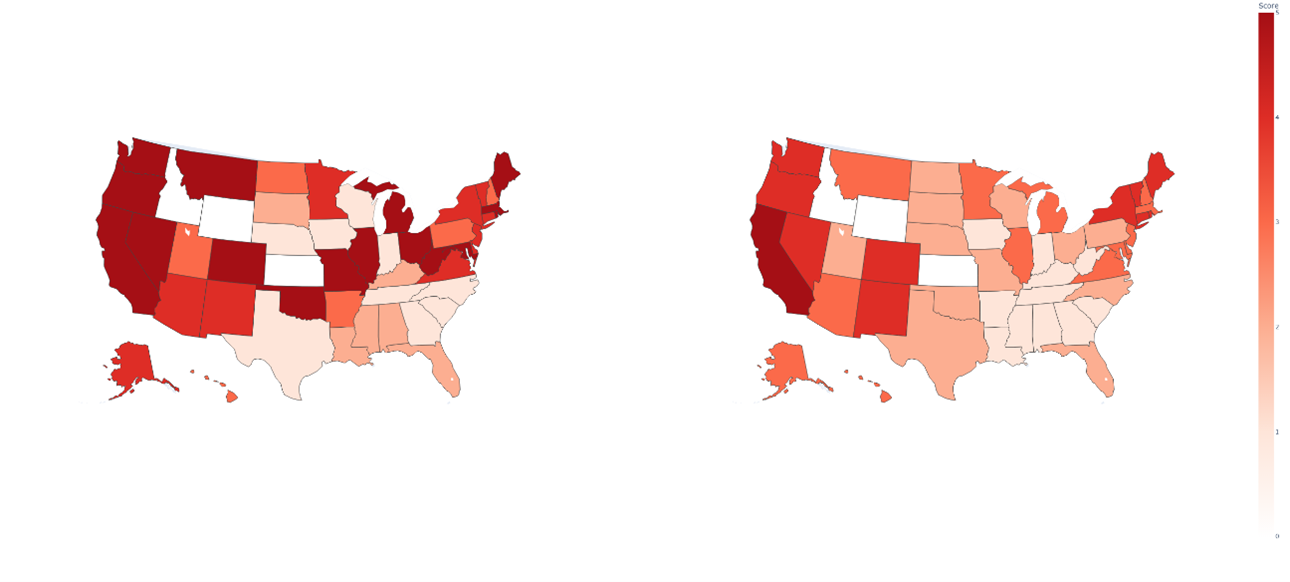
The heat maps below highlight a striking imbalance between cannabis tracking regulations and state-level data privacy protections.
The first map shows states with robust seed-to-sale tracking requirements, many of which require extensive collection and retention of customer information. The second shows the strength of state privacy protections.
The contrast is difficult to ignore. Many states that require businesses to collect extensive amounts of sensitive information have not adopted equally robust requirements for protecting it.
The result is a growing gap between:
- What cannabis organizations are required to track, and
- What they are required to safeguard.
This imbalance leaves dispensaries, technology vendors, and consumers exposed to risks that current regulatory frameworks were not designed to address.
Why Cannabis Data Breaches Are Different from Other Retail Breaches
At first glance, a dispensary data breach may seem similar to any other retail breach. However, the potential consequences can be far more personal.
A cannabis purchase history may reveal information about:
- Chronic pain treatment
- PTSD or anxiety management
- Cancer or end-of-life treatment
- Other private medical conditions
For some individuals, exposure of that information could create reputational, professional, or personal consequences that extend well beyond identity theft.
Consider someone who legally uses medical cannabis to manage a health condition. If their information is exposed in a breach, concerns about employment, professional licensing, insurance, housing, or personal privacy can suddenly become very real.
Whether those concerns are legally justified is almost beside the point. The fear of exposure itself can create meaningful harm.
This is what makes cannabis-related breaches different. The risk extends beyond financial fraud into privacy, employment, reputation, and personal security.
Real-World Cannabis Data Breach Examples
Recent breaches demonstrate that these concerns are not theoretical:
- A 2024 STIIIZY incident reportedly exposed hundreds of thousands of customer records.
- A 2025 Ohio-related breach reportedly exposed nearly one million patient records, including Social Security numbers and medical information.
As legal cannabis markets continue to grow, so too does the volume of sensitive information being stored across dispensaries, technology providers, and state-mandated tracking systems.
Key Cybersecurity Questions Every Cannabis Operator Should Be Asking
For cannabis operators, compliance should not be viewed as the finish line.
Organizations should be asking:
- What customer data are we collecting and why?
- How long are we retaining it?
- Who has access to it — internally and externally?
- What third-party vendors are storing or processing it?
- Have we tested our incident response plan?
- How quickly could we identify and respond to a breach involving customer information?
The organizations that answer these questions before an incident occurs will be significantly better positioned than those forced to answer them during a crisis.
The Future of Cannabis Cybersecurity and Consumer Privacy
The question is no longer whether cannabis businesses will collect sensitive information. They already do.
The more important question is whether cybersecurity, privacy protections, and incident response capabilities will evolve at the same pace as the industry itself.
As states continue to expand legal cannabis markets, the volume and sensitivity of consumer data will only increase. Without corresponding improvements in data protection, the gap between surveillance and safeguard will persist, leaving businesses and consumers exposed to risks that are increasingly preventable.
Frequently Asked Questions (FAQ)
What kind of personal data do cannabis dispensaries collect?
Dispensaries typically collect names, addresses, dates of birth, government ID numbers, medical marijuana card details, and detailed purchase history — including products purchased, quantities, and frequency of use.
Is dispensary data protected by HIPAA?
Generally, no. Most dispensaries are not considered HIPAA-covered entities, meaning their data collection and storage practices are not governed by federal medical privacy laws. Instead, they fall under a patchwork of state-level cannabis and privacy regulations.
Why is a cannabis data breach more sensitive than a typical retail breach?
A cannabis breach can reveal medical conditions, treatment patterns, and personal health information — creating risks tied to employment, licensing, insurance, housing, and reputation, not just financial fraud.
What is seed-to-sale tracking, and how does it affect consumer privacy?
Seed-to-sale tracking is a regulatory framework requiring cannabis businesses to track product movement from cultivation to consumer purchase. It often requires extensive collection of consumer and transactional data — but many states have not implemented equally strong data privacy protections to match.
Have there been major cannabis-related data breaches recently?
Yes. Notable examples include a 2024 STIIIZY breach exposing hundreds of thousands of customer records and a 2025 Ohio-related breach that reportedly exposed nearly one million patient records, including Social Security numbers and medical information.
What should cannabis operators do to improve cybersecurity?
Operators should evaluate what data they collect, limit retention, restrict access, vet third-party vendors, and build and regularly test a cybersecurity incident response plan that includes tabletop exercises.
What can cannabis consumers do to protect their privacy?
Consumers can ask dispensaries about their data practices, limit information shared at checkout, use unique passwords for dispensary apps, and monitor their financial accounts and credit activity for unusual activity.
This publication is intended for general information purposes only and does not and is not intended to constitute legal advice. The reader should consult with legal counsel to determine how laws or decisions discussed herein apply to the reader’s specific circumstances.